Book Review: Crucial Conversations
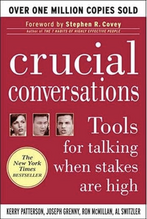
I finished reading the famous book on communication Crucial Conversations a few months ago this year. Crucial Conversations offers advice on how to deal with high stakes conversations in a business and work context. At the same time the advice can be applied to all areas of communication, including at home and in our personal lives. I read the first edition of the book that was published back in 2002 (found it online for free). As a strong communicator myself, this book has only sharpened my communication skills and taken my skills to the next level. I’ve had years of experience honing my communication skills and am always learning and trying to be better. This book is old but still very popular; I definitely got what I wanted from the first edition and am satisfied with the lessons learned. The book was a strong book overall and offers some frameworks that one can apply in day-to-day life. Here are the four frameworks within the book Crucial Conversations that I love the most:
The Path to Action: The Path to Action is the conceptual framework that underpins the whole book. People often do things for specific reasons, and it’s often based on stories told internally. Peoples’ Path to Action is based on four things that form a chain reaction. 1) We see or hear things that we believe are facts. 2) Based on facts, we tell ourselves stories that may or may not reflect reality. 3) The stories cause us to feel a certain way. 4) Because we feel a certain way, we take action. By understanding our psychology, we can trace things back to the source when we feel negative emotions. Always examine the stories and the facts behind every situation. Try to reframe negative stories into positive stories and always ask yourself: “What do I want?” This will help someone stay in the present moment in any situation.

STATE My Path: This is probably the book’s punchline. Whenever there’s an important conversation, it’s important to frame the conversation as a dialogue. The most important thing is the STATE My Path framework that induces dialog between the two parties. The framework is defined as follows:
- Share your facts: Start with the facts that you’ve observed and seen. It’s important to stick to facts, and not opinions.
- Tell your story: Share your side of the story based on the aforementioned facts that are irrefutable.
- Ask for others’ paths: Then ask for the other side’s path, or their side of the story.
- Talk tentatively: Talk in a manner that induces open-minded dialogue and encourages both sides to contribute their honest thoughts into the shared pool of meaning.
- Encourage testing: Give the other side the ability to test out ideas or say things that may be contrarian. Then work together to get to a mutual purpose.
This framework definitely makes sense and to do it well requires a lot of attention and care. I like how it breaks things down into a set of principles that will lead to dialog when followed.
Ask, Mirror, Paraphrase, Prime (AMPP): Colloquially referred to as AMPP, there are four techniques to become a better listener:
- Ask: Ask the other side to express themselves authentically and honestly. This is the first step in the communication process to steer the conversation towards positive dialog.
- Mirror: Mirroring the other person’s body language and tone of voice when they share their path is a good way to get them to open up. Mirroring is a tried and true method to get others to express themselves authentically, so use mirroring liberally!
- Paraphrase: This is where you rephrase what the other party said in your own words, and you bounce it right back over to them in order to seek feedback. This is a fantastic approach to keep the conversation going and to reach mutual understanding. It’s an approach that works well when two people are talking past one another. Use paraphrasing when you feel as if you don’t understand someone else and hopefully it eliminates the miscommunication.
- Prime: When others are not opening up, sometimes you have to take a risk and inject some energy into the conversation. You have to take a stab at what others may be thinking and say it openly, then communicate that it’s ok to talk about it. This gets the other party to open up and express themselves freely.
These four techniques are very powerful and I will try to incorporate them more into my conversations!
Agree, Build, Compare (ABC): When there is disagreement, the ABC framework can greatly enhance communication between two parties:
- Agree: Try to find agreement among the common points of contention. Always start with the areas of agreement and try to get to a common understanding first. This is important to take the temperature of the conversation down.
- Build: People often disagree on small matters when it comes to conversation, not big overarching matters. Therefore, agree first with the other party and then build on the points of minor disagreement or miscommunication. This helps to stabilize the conversation and steer it in the right direction.
- Compare: Lastly, compare each other’s paths if there’s major disagreements. See if both parties can get to a point where they “agree to disagree”. This helps to move onto bigger and better things to discuss! This helps both parties not get stuck in the mud and keep things moving.
These are all my thoughts from the book Crucial Conversations and I hope that you may have learned something new!