Book Review: Unicorn Tears

INTRODUCTION
I finished reading the book Unicorn Tears - Why Startups Fail and How to Avoid It by Jamie Pride and this was an incredible book! I would highly recommend this book to anyone who’s interested in startups and entrepreneurship, given that this book offers really practical suggestions on how to do things right when launching a new venture and what mistakes to avoid. The book can be found on Google and if you don’t have the time to read it, you can just read my summary and get the key points. The author Jamie Pride is from Australia and is someone who has launched and exited multiple startups. It’s very clear from reading the book that he has a lot of experience when it comes to avoiding startup mistakes in the beginning and how to do things right. This book was published in 2018 and at that time, Jaime was a founder who had done six technology startups, with one that was acquired; he was also an investor who helped complete an IPO for the Australian Stock Exchange in 2015. I trust what he says and found his advice in this book invaluable. I’m writing down the key ideas that I thought were super helpful! It’s no secret that +90% of startups fail and startups are high risk, high reward. The key question is: how does a startup avoid the mistakes that compound to failure and implement strategies that give the best chances for success? This book has the answers.
WHAT LEADS TO STARTUP FAILURE
The DNA of a startup: At the end of the day, a startup boils down to the intersection of these three components: 1) the founders, 2) the funding (i.e. capital), and 3) the business model. A startup will fail when you have glaring deficiencies in one of these three big areas. There could be multiple reasons why a startup fails, but it often boils down at the root-level to one of these three core reasons:
- Founder failures: The founders lack the character (capacity) or the technical skills (capability) to lead a team to execute on the stated mission of the startup. Or if it’s not the founders’ capacity or capability, then perhaps it’s an issue where there is founder disharmony.
- Funding failures: This one is pretty obvious, because a startup fails when it does not have enough capital to execute on it’s stated mission. Or counterintuitively, a startup can fail when it has too much funding and there is no sense of urgency in the execution. Lastly, it’s really important to do due diligence on any startup investor because founder-investor disharmony can also sink a startup.
- Flawed business model: The startup builds a product without validating the product in the market and whether it solves an actual business need. Also just as relevant, a startup with a good idea but poor execution can also derail the chances for success.
Ten specific reasons why a startup fails: For record keeping, I’m going to write down verbatim what the author identified as the ten most common reasons why a startup fails. It’s often not just a single reason, but a combination of the following reasons:
- Founder(s) lack capacity
- Founder(s) lack capability
- Founder disharmony
- Ran out of cash
- Too much funding
- Investor-founder disharmony
- Solving an irrelevant problem (desirability)
- Ineffective business model (viability)
- Poor execution (feasibility)
- External threats/competition (adaptability)
Understand that a startup is either default dead or default alive: This is actually a concept first attributed to Paul Graham of YCombinator, but I had never heard of it before. Basically the concept is that a startup in the beginning is either default dead: where it’s burning cash and has no credible revenue stream on the horizon or default alive: where it has revenue coming in and there’s a path towards break even and eventually profitability. If a startup is still default dead after 6-12 months of work, nothing is more important than getting a credible investor or paying clients/customers to bring in cash and get to a default alive state; nothing else matters because cash is the oxygen for any startup.
Do not be a wantrepreneur: Many founders try to do a startup for the wrong reasons. They want to do startups because it’s glamorous or because they are tired of working a corporate job. A startup and being a real entrepreneur is not glamorous AT ALL. The truth of the matter is: a real entrepreneur is always fighting fires and there’s always stress as to whether the venture is going to make it or not. A wantrepreneur is far more interested in the publicity and the clout of being an entrepreneur, but can’t actually execute and do the thing. Or if they try to execute, they are unfocused and not able to execute with speed, efficiency, and high quality. Avoid being a wantrepreneur at all costs. Focus less on conferences and LinkedIn posts, and more on grinding in silence everyday!
WHAT LEADS TO STARTUP SUCCESS
A startup succeeds best when the founding team complements each other in terms of skills: Launching a new venture by yourself is extremely hard. A one person startup is far harder than a team of people launching a startup. Therefore, it’s important to work with a team that complements you in terms of skill set, because one person cannot do everything and do it well. One interesting idea in the book is: the hustler, the hipster, and the hacker. A startup works best if the founding team has a hustler, hipster, and hacker where:
- The hustler is the sales and marketing founder.
- The hipster is the product focused founder.
- The hacker is the engineer and technical founder.
This is so true and to take it even further, I actually think that the hipster and product focused founder is also not essential. A startup can succeed if it has just a business focused co-founder paired with a technical co-founder, because both of these roles can shape the product development. The core of any company in the beginning is just: sales, marketing, and engineering. These are essential and non-negotiable because fundamentally: you need the product built and marketed to clients in order to make a sale to get cash!
Founders must have both capacity and capability: For startup founders, it’s important to have the capacity of good character and the skills needed to lead other people such that the group can execute efficiently. The founders must also have the capability and technical skills to actually do the job. If push comes to shove, capacity > capability in terms of importance because capability and skills can always be learned on the job. I did not honestly realize how important capacity was in a founder, but I agree with what the author says and it gives me areas where I need to improve. To build capacity, it comes down to three fundamental elements:
- Physical: Get good exercise, diet, and sleep.
- Mental: Develop self-awareness, empathy, and coachability. Take feedback well from all people.
- Emotional: Develop mindfulness, manage stress well, and be willing to always change your beliefs and biases.
At the end of the day, founders must always embody: resilience, adaptability, and awareness. Moreover, they must have empathy for their customers, investors, and employees alike. These personal character traits all help to ensure the startup has a higher chance of achieving success and makes the journey far less painful.
The product development should mirror the way a Hollywood movie is developed: Among the many great ideas in this book, this section of the book is by far to me the punchline of the book. It offers a plan on how to develop a product that achieves product-market fit in the most efficient and cost-effective manner. In Hollywood, movies undergo a four step process before the movie is finished: Development, Pre-Production, Production, and Post-Production. Though the process is not foolproof, this process gives the best chance for a movie to become a blockbuster and it has worked for Hollywood for the past 100+ years. In the same way, a startup’s product development can also be developed in a systematic way:
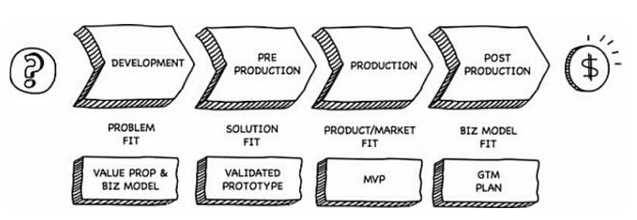
- Tease out the value proposition and business model: This is the most important thing before anything else when it comes to a startup. First, one must have a compelling value proposition and a business model that actually solves a customer need! Who is the customer and what are their pain points? Identify what the problem is and a value proposition that your startup will solve, then wrap everything in a business model. Remember that ideas are cheap, but wrapping the idea in a detailed business model is hard. This step involves a lot of talks with potential customers and would possibly involve formal interviews or surveys. This is all to establish whether your business could become a legitimate business one day and to establish problem fit.
- Build a prototype and validate it: This was something that I’ve never thought about and it’s rather genius! Many people think that to launch their business, they need the product built… uhm WRONG. In the beginning one has no idea if their product will actually solve a customer’s need; at the same time, hiring someone to build it costs enormous resources in terms of time and money. Therefore one ingenious solution would be to work out the user personas and customer experience journey, and then build out the wireframes and prototype only. Then go to the potential customers identified in step one and ask what they think to get feedback. This is a low fidelity way to validate solution fit, and will give clear insights whether the product will go on to achieve product-market fit. If at this stage people are happy with the prototype, then go and build the product in-house or hire someone to do it. If at this stage people clearly don’t like the product or see the value in it, then there’s no point in continuing and it’s more important to go back and iterate on your solution.
- Build the Minimum Viable Product (MVP): Now is the time to build the MVP! At this point, it should be a pretty seamless process and you have a cautiously optimistic feeling that there are people who will like the product after it’s fully built. Building is always fun, but people have to realize that a startup is never about the technology, but rather it’s always about the business. The technology is only as good as one’s ability to market and sell it to a customer who has a need for it. Only if the need is real will they actually pay you money. With all the work done in step two, giving the prototype design to a developer has the added benefit of eliminating any misunderstanding on what needs to be built, saving you both money and time. The MVP is ready to be launched to formalize the business!
- Develop the Go-to-Market (GTM) plan and implement it: This part I think a lot of people are familiar with. At this point the startup has achieved product-market fit and may have a few paying customers. Now it’s important to think about scaling and how to acquire even more customers. This is where Customer Acquisition Cost (CAC) and the stuff that you learn in business school comes in. I don’t have extensive thoughts on this part given that so few startups reach this stage, but for the startups fortunate enough to reach this stage, it’s a fun time where all the hard work is validated by paying customers! Develop a good GTM plan and execute aggressively.
Great questions to ask a potential investor: This I’m taking verbatim from the book because I think these questions are excellent:
Questions on the Investor’s Experience
- How many deals have they done? Over what time frame?
- When did they make their last deal?
- Do they lead or co-invest alongside someone else?
- Do they follow on or only make single investments?
- What is the size of their average check?
Questions on the Investor’s Personal Network
- Do they have experience in your domain?
- Can they help with customer referrals?
- Are they a former founder? Can they help coach you?
- Are they prepared to sit on the advisory or actual board?
- Are they connected to other investors?
- Can they help close out the round?
As you can see, I learned so much from this short book Unicorn Tears. There are so many lessons in the book and I’m truly glad that I ended up reading the book. The author is a good person and was honest, which is not always the case in the startup world. I hope you also learned something if you made it to the end of this long blog post!