Book Review: Prometheus Bound - Aeschylus
“All that shall come to pass; no sharp surprise
Of pain shall overtake me; what’s determined
Bear, as I can, I must, knowing the might
Of strong Necessity is unconquerable.” - Prometheus
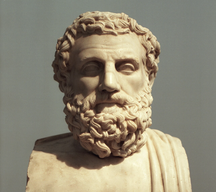
I just finished reading the Greek tragedy Prometheus Bound by Aeschylus (Pronounced: eh-skul-luhs). I’m trying to study Classics again and this is the first Greek tragedy I’ve read in around ~20 years. In high school I remember reading Oedipus Rex by Sophocles, but I didn’t take it that seriously and didn’t find English literature that interesting. Times have changed, and literature becomes far more interesting when you study it yourself outside of the academic context. I want to work my way up to eventually read The Iliad and The Odyssey by Homer (which I’ve never read before), as well as all the works of Shakespeare. I’ve picked up reading for maybe ~11 years now and have read overwhelmingly non-fiction. Now I would like to move over to fiction, starting with the Greek and Latin Classics.
Aeschylus is known for writing fictional tragedies, which often explores how a tragic hero with good intentions endures suffering and destruction in a corrupt world. The tragic hero often pays the ultimate price. Prometheus Bound is no exception and it’s the only surviving text in a three part trilogy by Aeschylus. It’s a relatively short play and it’s a good introduction to get back into reading Classics, which can be very intimidating to get into because of the non-modern English style. But with help from the trusty Sparknotes (which I’m sure many people are familiar with lol), I managed to finish reading Prometheus Bound and understand everything.
Prometheus Bound tells the story of Prometheus, who’s a titan (an Olympian God) who helps his fellow titan Zeus achieve power. Through a war among the Gods and with Prometheus’s help, Zeus becomes the all-powerful God that reigns from Mount Olympus. Zeus is depicted as a tyrant in the play, and he has little regard for humanity living on Earth. In fact, he intended to destroy humanity from the face of the Earth. This is where Prometheus the tragic hero steps in. Prometheus’s character is rooted in foresight, courage, and doing the right thing; the word Prometheus in Ancient Greek literally means “forethought”. Prometheus disobeys Zeus and gives humanity the gifts of: fire, hope, language, agriculture, navigation, medicine, and religion, with fire being the most important gift of all for humanity’s survival. As a titan, Prometheus steals fire from Mount Olympus and gives it to humanity on Earth, a selfless act that’s totally unintuitive and unheard of. He showed compassion to the human race and wanted to give them a fighting chance from their inevitable destruction at the hands of Zeus. However to Zeus, this is a BIG sin. Zeus is enraged by what Prometheus did and orders Prometheus bound to a rock at the edge of a cliff by his henchmen. Prometheus goes from being a titan to being bound to a rock and humiliated, someone who suffers the sudden loss of his power. Throughout the play, Prometheus experiences the following:
- Chained to a rock by Hephaestus (Olympian God of Fire), under the supervision of Kratos (personification of Strength) and Bia (personification of Force) .
- Visited by the Chorus of the Oceanides (daughters of the Titan Oceanus), who’s sympathetic to Prometheus and basically the only true friends of Prometheus in his suffering.
- Visited by Oceanus himself (Titan of the Ocean), who wants to help mediate the relationship between Prometheus and Zeus. However Prometheus refuses to pander to Zeus, and he and Oceanus cannot reach an agreement. Oceanus regrettably leaves and cannot help his fellow titan.
- Prometheus, with the power of foresight, knows that Zeus will need him in the future to foil all the plots perpetrated against the sovereign Zeus. Prometheus also knows that Zeus will one day cause his own downfall by marrying someone who will birth a son stronger than Zeus himself. This knowledge is what gives Prometheus hope and why he believes he will eventually be freed from his chains. It’s his great secret.
- Visited by Io, a princess whom Zeus falls in love with; to hide the tryst, Zeus transforms her into a cow and sends her away. To add insult to injury, Hera (the jealous wife of Zeus) sends a gadfly to attack Io continuously after she finds out about the affair. Prometheus sympathizes with Io and begrudgingly tells her of her future journey and sufferings when she desperately seeks this information. Io suffers total madness.
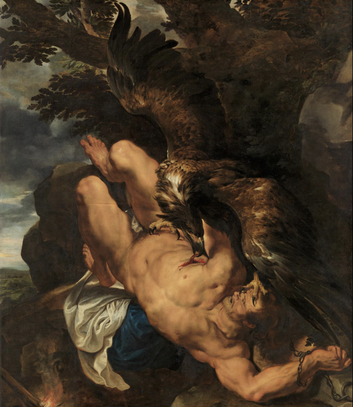
- Visited by Hermes, a messenger of Zeus. Hermes demands that Prometheus reveal anything critically important about Zeus’s future. Prometheus refuses Hermes and chides him for being basically a parrot of Zeus. Hermes threatens Prometheus that his suffering is about to get worse: Zeus will send a lightning bolt to the craig that Prometheus is chained to, causing him to be buried into the Earth and in the dark for a long time. Then, he will be brought back to the Earth and into the light where Zeus will send an eagle to eat his liver everyday. The eagle will attack Prometheus’s liver during the day, the wound will heal in the night, and the eagle will attack again the next day ad infinitum. Prometheus does not budge and remains resolute.
- The play ends with Prometheus swallowed into the Earth when a lightning bolt strikes. Interestingly the Chorus of Oceanides, who had multiple times to escape, chose to suffer the same fate as their friend Prometheus.
Prometheus is a true inspiration for all underdogs, especially an underdog facing an opposing force of overwhelming might and power. Prometheus was willing to pay the ultimate price for what he believed in and for what he knew was the right thing to do. He never wavered in believing in himself and suffered pain that no one else was willing to suffer. He was hurting, but never actually gives up or loses his spirit. He remained steadfast in who he was and the light that shines out of him through his endurance is strong and inspiring. Some might say he was stubborn or stupid, but I say: When something is important enough, you do it in spite of the fear and the consequences. Reading about the tragedy of Prometheus causes us to think about the following questions:
- Why let injustice or unfairness be perpetrated with no checks and balances?
- Why let the people in power commit corruption as one stands idly watching?
- Why not do something about it, in spite of the consequences and fear?
- If one’s afraid to take action and do what’s right, why?
The tail of Prometheus is not just a work of fiction, it speaks to power structures, hierarchy, and the abuse of power that happens in real life everyday. People in power often do morally questionable things, and then when someone morally strong stands up to them, they will do everything they can to maintain their power and bring the challenger down. The challenger may be brought down or removed eventually, but the long-lasting impact made by the one who dared to stand up for what’s right will not be gone anytime soon. The impact will be there in perpetuity forever. I respect the story of Prometheus a lot and I see a lot of myself in Prometheus. They key virtue and lesson learned: It’s all about the will to do what’s right and to live with integrity, even if one is destroyed.
Sources:
- Prometheus Bound Summary (MoAn Inc. was a helpful resource in writing this blog post)