Book Review: Plutarch's Lives (Vol. 4)
Introduction
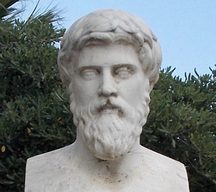
I’ve started reading the book Plutarch’s Lives by the Greek historian and biographer, Plutarch (50-120 AD). This book is so big that it’s broken down into multiple volumes and will probably take me many years to finish reading end-to-end. Plutarch’s Lives has influenced many consequential people throughout history, including many of America’s founding fathers like: George Washington, Alexander Hamilton, and Abraham Lincoln. The book is a biographical collection of venerated Greeks and Romans, forming 23 pairs of lives that are then compared and contrasted. Most of the book is present and preserved from antiquity, but parts of the book are missing. I’ve become an amateur historian in the past few years because of the following reason: we can only know where we’re headed in the future by studying where we’ve been in the past. By developing character and virtue, we can all be better individually and that will translate into society being better collectively. These are my thoughts and notes as I work through Plutarch’s Lives (Vol. 4) - A. H. Clough!
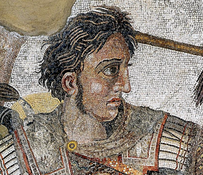
Alexander the Great
“My son," said she, “thou art invincible.” - Said to Alexander by the Oracle of Apollo at Delphi
Alexander the Great of Macedonia (356-323 BC) is one of the lives Plutarch writes extensively about. In fact, Plutarch’s writings about Alexander the Great is the first biographical profile we have of who Alexander is. Alexander is most famous for building one of the largest empires in ancient history that stretched from Greece all the way to India. Legend has it that Alexander tamed the horse Bucephalus at age ~12-13 when no other person could, proving his courage to his father Phillip II. Philip subsequently told Alexander: “O my son, look thee out a kingdom equal to and worthy of thyself, for Macedonia is too little for thee.” Alexander assumed power as King of Macedon at age 20 when his father was assassinated. Alexander had a world view shaped by his fantastic tutor Aristotle who taught him good character; he always had an inherent self-belief, drive, and total conviction in what he was doing. He was allergic to living comfortably and was never afraid of danger, viewing his glory as more important to him than comfort or worldly pleasures. In the span of four years, he defeated Darius of Persia and conquered most of the known world. Then he pushed further beyond Persia, into the far east, reaching as far as India. He died at age ~32 and left a legacy that shaped the world forever. What I found interesting in Plutarch’s profile were the following character traits that we may perhaps learn something from:
- Alexander had an unshakeable self-belief. He literally believed that he could do anything and that he was going to succeed in all that he did. Literally nothing fazed him, and that’s what made him an inspiring leader.
- Alexander was characterized by a strong obstinacy. When he decided on an objective, he stopped at nothing to achieve that objective. He was never afraid of any danger in battle and often led from the frontlines. He was often personally injured in battles and had to be resuscitated back to nominal health, enduring extreme pain.
- Alexander lived with temperance his whole life. He was not a big fan of excess indulgence in food or the pleasures of life. Rather he partook in those things sparingly, almost viewing them like one would view a household chore. What did light his fire was glory and the possibility of making an impact on a grand scale.
- Alexander was magnanimous with his materials, wealth, and mercy. He often treated his soldiers well, as well as the people he defeated in battle mercifully. He was fierce in battle, but also just as gracious when he did win. He respected friends and foes with courage and guts, because that’s who he was and he saw himself in anyone with those traits.
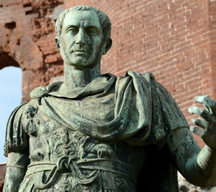
Julius Caesar
“The die is cast.” - Julius Caesar as He Crossed the Rubicon River
Julius Caesar (100-44 BC) is one of the most impressive people in all of human history in terms of determination and results achieved. In fact the month of July is named after him, which is a wild fact. But like all people, he had his fair share of flaws and character deficiencies too. In Plutarch’s Lives, we see that Caesar’s character can be best summarized by a famous story from his youth. At age 25, Caesar was captured by Cilician Pirates in the Aegean Sea. The pirates seized Caesar + his ship and demanded a ransom of 20 talents of silver. Scoffing at the price, Caesar believed his life was worth more and insisted that they raise it to 50 talents of silver. While in captivity Caesar acted with confidence, and teased the pirates in good humor that he would have them crucified once freed. The pirates did not take him seriously and thought (paraphrasing here): no way, this kid is just playing around! After the ransom was raised and paid, Caesar did exactly what he said he would do: he raised a fleet, found the pirates, and took action to crucify each and every one of them. We can see from this story that this was someone who meant what he said and didn’t play games!
Caesar then rose through the ranks of the Roman political establishment and formed The First Triumvirate with Pompey (Rome’s greatest general at the time) and Crassus (Rome’s richest person) in 60 BC; together the three wielded power like no others. In 59 BC he was elected consul and then in 58 BC a five year proconsul command of Gaul (present day France), thereby accumulating even more power. Caesar at this point was also heavily in debt from putting out public spectacles (gladiator fights, statue building, trophy commemorations, etc.) to garner political support among the Roman populace. His solution was to escalate the situation in Gaul and engender a full-blown military conflict: the Gallic Wars (which I’ve written about extensively here). The Gallic Wars were a vicious affair, but Caesar achieved total dominance over all of Gaul after the Battle of Alesia (52 BC) with the surrender of Vercingetorix.
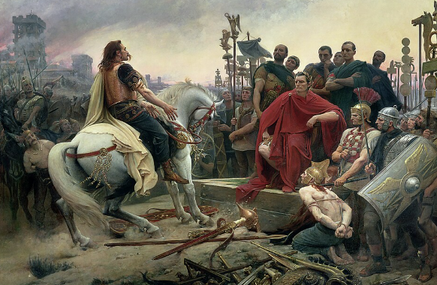
Vercingetorix throws down his arms at the feet of Julius Caesar - Lionel Royer (1899)
After the Gallic Wars, Caesar had political enemies in the Roman establishment who wanted to take him down a notch given his immense success and power accumulation. The Senate demanded that he disband his army, but Caesar refused. At this point, Crassus was dead and Caesar and Pompey were no longer allies but bitter rivals. Pompey aligned himself with the Senate and Caesar aligned himself with his battle-tested army under his sole control. Weighing the risks on whether to take on the powers of the Roman Republic, knowing that this would trigger the full forces of the political and military establishment against him, Caesar ultimately decided to do it anyway. He famously marched on Rome by crossing the Rubicon River with his 13th Legion, truly a point of no return. This is where we get the expression used today: “crossing the Rubicon” which means “a point of no return.” A Civil War broke out soon after where Caesar was victorious over his once political ally Pompey, winning a decisive victory at the Battle of Pharsalus (48 BC). During the Civil Wars, Caesar chased Pompey to Egypt and that’s where he met Cleopatra, and the two had a son.
After the Civil Wars, Caesar returned to Rome as a dictator and had absolute control. He implemented reforms very fast according to his ideals, which alarmed his political enemies in the Senate as well as the populace that once loved him unconditionally. His enemies feared his powers and formed a secret plot to assassinate him, with his trusted advisor Brutus in on the action. On the Ides of March in 44 BC, Caesar was assassinated in the Roman Senate building when the conspirators all pulled out daggers and each stabbed him in an enclosed circle. Ironically, this happened under a statue of Pompey of all people; can we say spooky?! What we can learn from Caesar:
- Caesar was of good humor and affability. He was able to transcend and relate to people of different classes: high society and the upper class, the populace and the middle to lower class, soldiers that were deeply loyal, and even outlaws like the pirates.
- Caesar was a man of action and ambition. Caesar was not afraid to go after what he wanted and did things with vigor and vitality.
- Caesar’s thirst for power led to his downfall. The strengths that made him such a good statesman and military commander led to his downfall during his dictatorship. By that time, he lost the pulse of the Roman Senate. As his powers grew, many senators feared the loss of the Roman Republic.
To be continued as I work through more lives…